Three words, one place — most of the time. Travellers say "FBO", the industry says "business aviation terminal", and almost everyone says "private jet terminal" when they mean the discreet building where private flights begin. The terms overlap, but they are not perfect synonyms.
The short answer
In practice, FBO, business aviation terminal and private jet terminal describe the same thing: the private side of an airport, away from the main commercial concourse. The difference is one of emphasis and region, not of place. "FBO" names the operator and is American in origin. "Business aviation terminal" names the building and is the European, industry-facing phrase. "Private jet terminal" names the experience and is how travellers talk. At a busy airport, all three can point to the very same lounge, ramp and fuel truck.
The catch is that the words do not map one-to-one. One airport may have a single terminal building shared by several competing FBOs. Another may have an "FBO" that is really just a flight office and a stretch of apron. So when someone says "the private jet terminal at this airport," ask which one — there may be more than one.
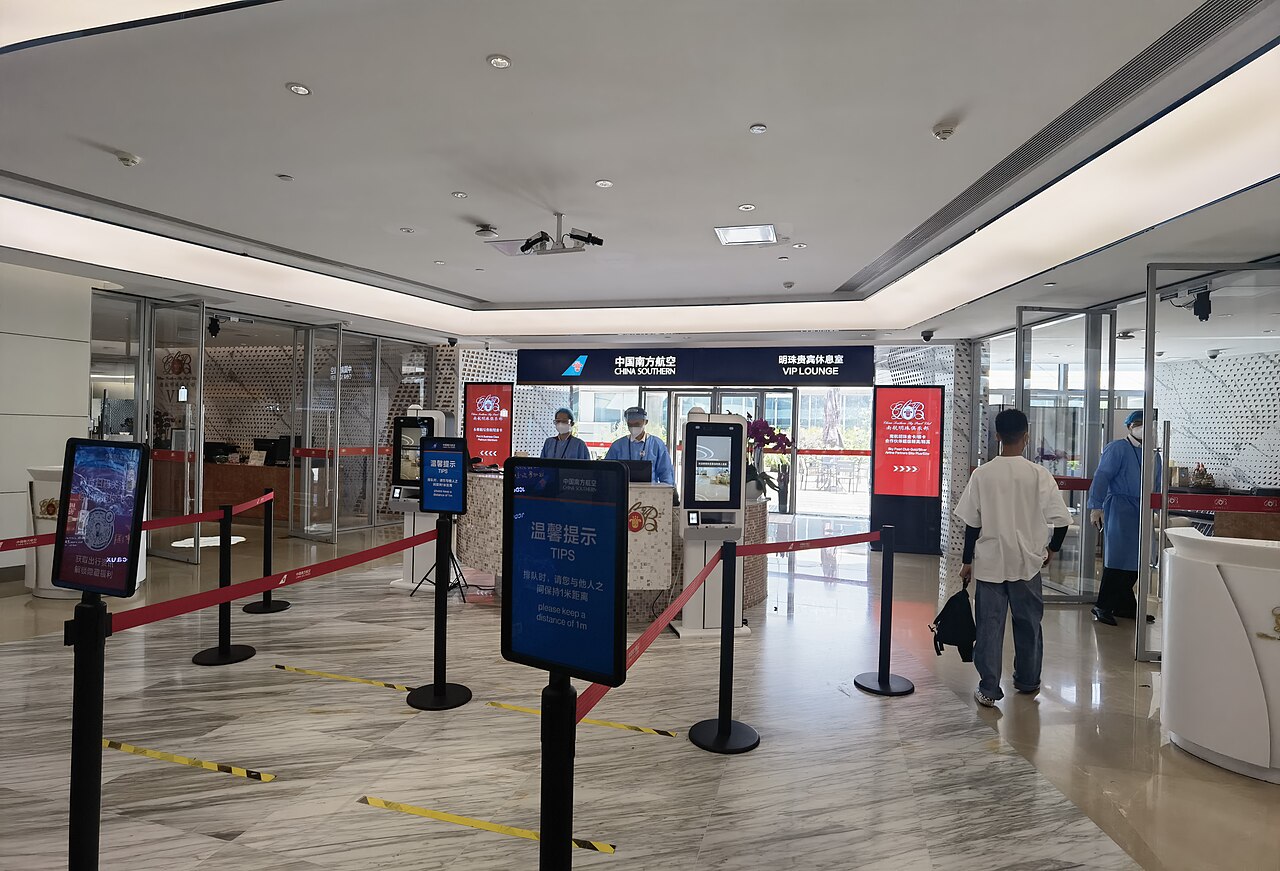 A private jet terminal lounge. The format scales from a single waiting room to a multi-storey VIP building. Photo: Wikimedia Commons, CC BY-SA.
What an FBO actually is
An FBO (Fixed-Base Operator) is a business. It is a company licensed by the airport authority to provide services to general and business aviation: fuel, ground handling, ramp space, customs coordination and passenger facilities. The word describes who provides the service, not the building it happens in.
The term is American. It dates from the years after the Air Commerce Act of 1926, which pushed civil aviation toward licensed, location-based operations. Companies that set up a permanent business at an airport became fixed-base operators, as opposed to the itinerant pilots who had no permanent base1. The phrasing is operator-centric by design: an FBO is a firm with a name, a fuel contract and a service desk.
Because it names a company, "FBO" carries a competitive edge that the other two terms do not. At one airport you can have several FBOs, each with its own lounge, its own apron and its own pricing. You choose between them. For a fuller treatment of the concept, see our explainer on what an FBO is.
"Business aviation terminal": the building
"Business aviation terminal" is the European and industry-facing phrasing. It names the facility — the physical building and apron set aside for private and corporate flights — rather than the company that runs it. Regulators, airport operators and trade associations favour it because it is neutral and infrastructural.
The emphasis matters. When an airport authority publishes a master plan, it refers to a "business aviation terminal" or "general aviation terminal" as a piece of infrastructure, the same way it would refer to a cargo terminal or a fire station. At Geneva (LSGG) or London Farnborough (EGLF), the building is the constant; the operators inside it, or alongside it, can change over time.
This is the most precise of the three terms when you care about the structure itself: gates, lounges, customs hall, ramp access. It says nothing about service quality or branding. It simply marks where on the airfield business aviation lives.
"Private jet terminal": the experience
"Private jet terminal" is the colloquial, traveller-facing phrase. It is rarely used inside the industry and almost never in regulation, yet it is what most passengers type into a search bar. It emphasises the experience: a short walk instead of a two-hour queue, a quiet lounge instead of a crowded gate, a car at the foot of the aircraft.
The phrase is imprecise on purpose. A passenger does not care whether the building is technically a "terminal" or whether the company is an "FBO" — they care that they arrive, are greeted, and board within minutes. "Private jet terminal" captures that promise in three words. It is marketing language that became everyday language.
For the same reason, it travels well across borders. The American "FBO" and the European "business aviation terminal" both translate awkwardly; "private jet terminal" needs no translation. That is why it dominates online search even where the local industry would never use it.
 A business jet cabin. The terminal experience on the ground is calibrated to match the cabin in the air. Photo: Wikimedia Commons, CC BY-SA.
Comparison: three terms, side by side
The table below sets out who uses each term, what it emphasises, and where you are most likely to hear it.
| Term | Who uses it | What it emphasises | Typical region |
|---|---|---|---|
| FBO (Fixed-Base Operator) | Pilots, brokers, charter staff, operators | The company providing fuel and handling | United States; global trade |
| Business aviation terminal | Airport authorities, regulators, trade bodies | The building and infrastructure | Europe; official documents |
| Private jet terminal | Passengers, the press, search engines | The experience of flying private | Everywhere, especially online |
| General aviation terminal | Airport planners | The facility, including non-jet GA | Both; planning context |
Read across any row and the underlying place is often identical. The word you reach for says more about who you are than about where you are standing.
Where the difference actually bites
Most of the time the three terms are interchangeable. The difference bites in two specific situations, and both come down to a mismatch between buildings and operators.
First, one building, several operators. A large hub such as Paris–Le Bourget (LFPB) or Teterboro (KTEB) can host multiple competing FBOs. Asking for "the private jet terminal" is ambiguous — there are several, each with its own apron and its own fees. Handling charges can vary two- to threefold between terminals at the same airport, so picking the right FBO is a real decision, not a formality.
Second, one operator, almost no building. At a smaller field such as Luton (EGGW)'s quieter neighbours or a regional aerodrome, an "FBO" may be little more than a flight office and a patch of ramp. Calling that a "terminal" oversells it; calling it an "FBO" is technically correct but conjures a grander image than reality. Here the words drift apart in the other direction.
- Same place, different word: a passenger's "private jet terminal" is a broker's "FBO" is a regulator's "business aviation terminal."
- Different places, same word: "the private jet terminal" at a multi-FBO airport could mean any of three buildings.
- Practical rule: when it matters operationally, name the FBO, not the airport. That removes the ambiguity.
For more detail on the building itself and what happens inside, see inside a private jet terminal.
Finding the right one for your flight
So: FBO, business aviation terminal and private jet terminal usually mean the same place, seen from three angles — the operator, the building and the experience. The vocabulary only matters when an airport has several FBOs, or when an "FBO" turns out to be a flight office on an apron. In both cases the fix is the same: identify the specific terminal, not just the airport.
That is what a directory is for. Use the FBO Finder map to see every FBO at a given airport, filter by services such as customs or hangar, and compare them before you call. For a step-by-step approach, read how to find an FBO. Whichever word you started with, you will end up at the right door.
Sources
Article last updated June 2026. If you manage an FBO and spot any inaccuracy, email editorial@fbo-finder.com — we'll review and correct within 48 hours.
Footnotes
-
Fixed-base operator — Wikipedia. Origin and meaning of the term after the Air Commerce Act of 1926. ↩