If you've ever flown private — or if you're considering it — you've already brushed up against an FBO without necessarily knowing the term. It's the small, discreet terminal tucked somewhere off the main runway, where a short walk replaces the two-hour commercial airport ritual. In business aviation, the FBO is where the entire experience happens. Here's the complete picture.
FBO stands for Fixed-Base Operator
An FBO (Fixed-Base Operator) is a commercial business granted the right by an airport authority to provide services to general and business aviation. In practice, that means everything the commercial airlines take care of themselves — fuel, ground handling, customs, lounges, hangar parking — but scaled for private flights.
The term emerged in the United States after the Air Commerce Act of 1926, which introduced pilot licensing and aircraft maintenance standards. Before that, civil aviation was dominated by barnstormers — itinerant pilots and mechanics who flew from city to city without a permanent base. As the 1926 Act pushed the industry toward regulated, location-based operations, companies that established permanent businesses at airports became the fixed-base operators, in contrast to the transient kind. The name stuck1.
Today, FBO and private jet terminal are used interchangeably. Browse the FBO Finder map and you'll see 4,776 of them across 3,556 airports.
 A business aviation terminal building. Photo: Wikimedia Commons, CC BY-SA.
What services does an FBO provide?
A modern FBO is a one-stop shop for private aviation. A typical one offers:
- Passenger handling: curbside arrival, quick security, short walk to the aircraft — typical door-to-wheels-up under 15 minutes.
- Crew lounge and briefing rooms: weather, NOTAMs, route planning.
- Aircraft fuelling (Jet A, Jet A1, sometimes avgas).
- Hangar and ramp parking for overnight or longer stays.
- Customs and immigration for international arrivals (when the airport has a customs officer on duty, or by prior arrangement).
- Concierge: ground transport, catering orders, hotel bookings, helicopter transfers.
- Meeting rooms for last-minute conference calls before take-off.
- Rest suites, showers, Wi-Fi.
The bigger FBOs add private VIP terminals, on-site customs lounges, art-gallery grade finishes, and concierge teams that handle anything from ski-in ski-out logistics to yacht transfers.
FBO vs commercial airport terminal
The practical differences are stark:
| Commercial terminal | FBO | |
|---|---|---|
| Arrival time before departure | 2 hours | 15–30 minutes |
| Security | Mass screening | Discreet check |
| Passport control | Queues | Handled in lounge |
| Luggage | Check-in / carousel | Direct to aircraft |
| Waiting area | Shared, crowded | Private lounge |
| Parking | Long-term lots | Valet at the door |
The value of an FBO isn't just comfort. For a charter operator, a missed slot at a busy airport costs thousands. For a broker, a good FBO means on-time departures and happy clients. For a flight crew, it's coffee, a weather brief and a clean lavatory turnaround.
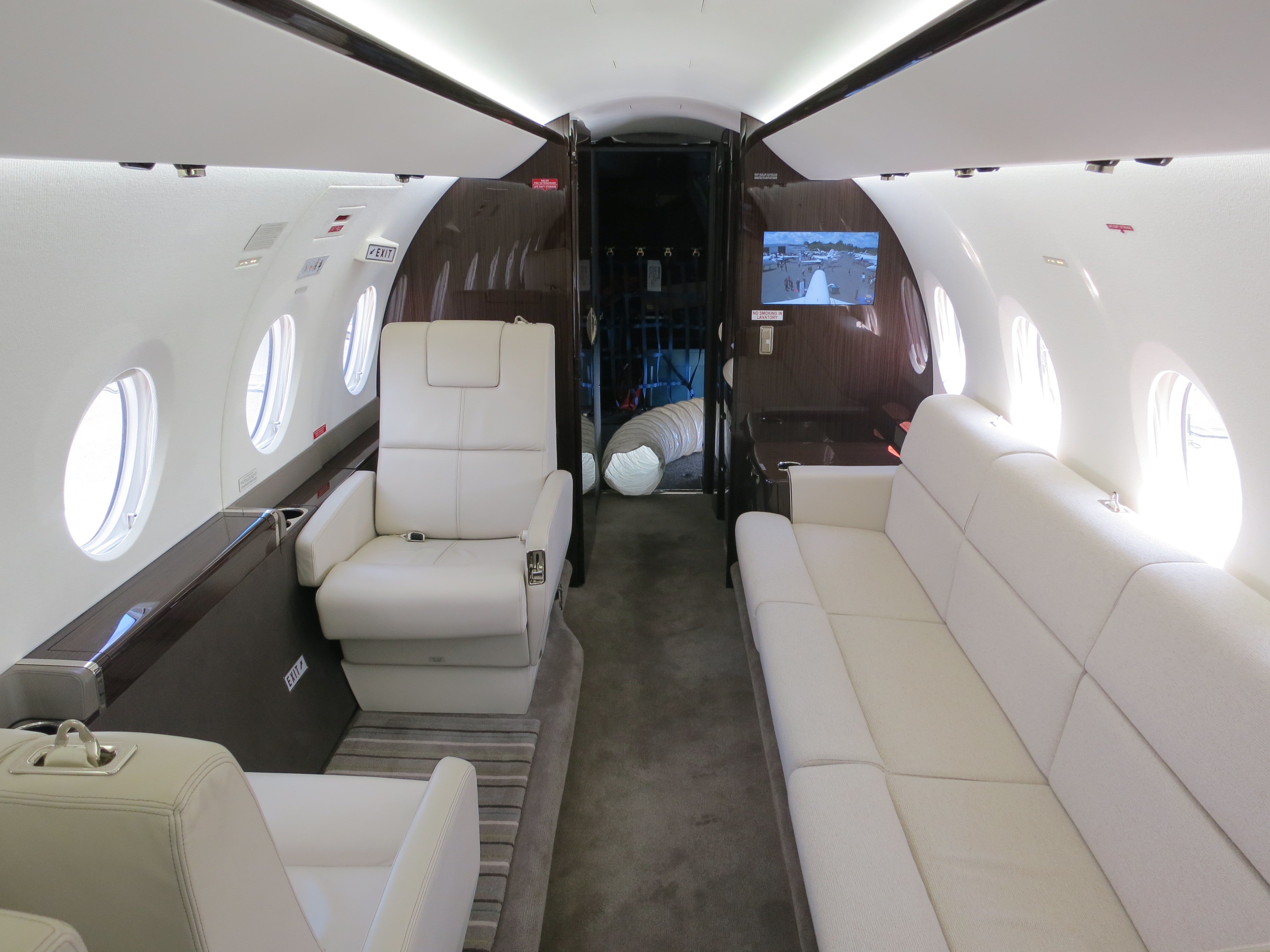 Inside a Gulfstream G280 business jet. The "terminal experience" at an FBO is calibrated to match. Photo: Wikimedia Commons, CC BY-SA.
How are FBOs organised at a single airport?
A large business aviation hub usually hosts multiple competing FBOs. FBO Finder's directory shows six operators listed at Paris Le Bourget (LFPB), one of Europe's busiest business jet airports: Jetex Le Bourget, Signature Flight Support, Advanced Air Support, Universal Aviation Le Bourget, ExecuJet Le Bourget and Dassault Falcon Service. Each has its own terminal, its own ramp, its own fuel contracts. A captain picks one based on ramp fees, fuel prices, customer relationships, or client preference.
Smaller regional airports often have only one FBO — sometimes run by the airport authority itself. At a GA (general aviation) aerodrome with no commercial handling (like Saint-Cyr-l'École (LFPZ) near Paris), there may not be a classical FBO at all — just an airport office that handles PPR (Prior Permission Required) requests on demand.
 A regional FBO terminal building — Leading Edge Aviation at Doylestown Airport (Pennsylvania). The format scales from a single-room flight office to multi-storey VIP terminals. Photo: Wikimedia Commons.
Who uses FBOs?
- Private jet owners and their pilots
- Charter operators (NetJets, VistaJet, Flexjet, GlobeAir, and hundreds of regional operators)
- Brokers arranging flights for clients
- Corporate flight departments of Fortune 500 companies
- Heads of state and diplomatic missions (often through specialised FBOs with enhanced security)
- Cargo operators for high-value or time-critical freight
FBO Finder lists every commercial FBO we can verify, alongside the small airport-operated handling offices at regional fields.
How to choose the right FBO
Captains and brokers typically balance five factors when picking an FBO for a given flight:
- Ramp and handling fees — can vary 2–3× between FBOs at the same airport.
- Fuel price (posted price vs contract).
- Services offered — does the airport have customs? Is an engine heater available in winter?
- Proximity — which end of the ramp is closer to the city exit?
- Reputation — crew and passenger experience, response time, quality of catering.
The FBO Finder map lets you filter by services (customs, hangar, 24/7), see partner terminals first, and read authentic reviews from pilots, brokers and passengers.
The FBO market today
Business aviation has rebounded strongly from the 2020 pandemic slump and remains one of aviation's most resilient segments, according to the European Business Aviation Association2. Global networks like Signature Aviation, Jetex, Universal Aviation and ExecuJet keep expanding through acquisitions, but independent FBOs still dominate locally — especially in Europe, where each country has its own flavour: SEMAT at Le Touquet, Paris-Vatry Handling at Châlons-Vatry, Dassault Falcon Service at Le Bourget, Signature at Geneva. FBO Finder lists all of them alongside smaller regional handlers.
Whether you're a passenger looking for the private terminal at your destination, a broker comparing options for a client, or an FBO manager wanting to claim your listing, FBO Finder is the directory of private jet terminals — 4,776 FBOs worldwide, always free to search.
Sources
- Air Commerce Act of 1926 — FAA History. U.S. regulatory origin.
- FBO Finder internal directory — verified terminal data for Paris Le Bourget and other airports mentioned.
Article last updated April 16, 2026. If you manage an FBO and spot any inaccuracy, email editorial@fbo-finder.com — we'll review and correct within 48 hours.
Footnotes
-
Fixed-base operator — Wikipedia. Post-Air Commerce Act (1926) origin of the term. ↩
-
European Business Aviation Association (EBAA) — Industry statistics. Traffic and market data. ↩