When you book a charter flight or hear someone describe a jet by its "category," they're using a long-standing industry classification. Business jets are grouped by range, cabin size and passenger capacity into six widely-recognised tiers1. Here is each one, with the real-world aircraft that define it.
1. Very Light Jets (VLJs)
- Typical capacity: 6–7 passengers
- Typical range: ~1,170 nm (~2,170 km)
- Aircraft: Cessna Citation Mustang, Embraer Phenom 100, HondaJet HA-420, Cirrus Vision SF50
The VLJ segment was invented to fill the gap between turboprops and traditional business jets. They're single-pilot certified, modest in cabin volume, and can land on shorter runways — making them excellent for intra-European hops or U.S. point-to-point inside a 2-hour block. The Cirrus Vision is unique in the category as a single-engine jet with a full-aircraft ballistic parachute.
Best for: 1–2 hour flights, 3–4 adults, one-day return trips.
 HondaJet HA-420 — a VLJ with a distinctive over-the-wing engine mount. Photo: Wikimedia Commons.
2. Light Jets
- Typical capacity: 6–8 passengers
- Typical range: ~1,950 nm (~3,610 km)
- Aircraft: Embraer Phenom 300, Cessna CitationJet series (CJ3, CJ4), Learjet 40/45, Hawker 400XP
Light jets are the workhorses of the charter market. The Phenom 300 has been the most-delivered business jet in the world for 12 consecutive years as of 20242 — its combination of cabin comfort, short-field capability and operating economics is hard to match. A light jet will typically cross continental Europe nonstop (Paris → Athens is feasible) but not the North Atlantic.
Best for: 3–4 hour flights, 4–6 adults, medium-distance trips inside a continent.
3. Midsize Jets
- Typical capacity: ~9 passengers
- Typical range: ~2,540 nm (~4,700 km)
- Aircraft: Cessna Citation Excel / XLS / XLS+, Hawker 800 / 900 / 1000, Learjet 45 / 60
Midsize jets add a stand-up cabin (typically ~1.73 m / 5'8" cabin height), a proper galley, and an enclosed lavatory. They're the sweet spot for corporate shuttle operations: enough cabin to work and eat, but still economical enough for 1–2 hour regional flights. The Citation XLS+ is the ubiquitous midsize, with around 1,000 units built.
Best for: 4–5 hour flights, 6–8 adults, business meetings where you need to work en-route.
 The Cirrus Vision SF50 — a single-engine personal jet with a full-aircraft ballistic parachute. A category-redefining aircraft. Photo: Wikimedia Commons.
4. Super Midsize Jets
- Typical capacity: 10–11 passengers
- Typical range: ~3,420 nm (~6,330 km)
- Aircraft: Cessna Citation Longitude, Cessna Citation Sovereign, Bombardier Challenger 350 / 3500, Gulfstream G280
The super-midsize class is where things start to feel large. Cabins become noticeably taller and wider, onboard Wi-Fi is standard, and you can fly transcontinental U.S. nonstop (New York → Los Angeles) or cross the Mediterranean without breaking stride. The Challenger 350 has dominated this category and was recently refreshed as the Challenger 3500.
Best for: Transcontinental trips, 8–10 passengers, full galley catering, lie-flat seating for overnight flights.
 NetJets-operated Bombardier Challenger 350, the super-midsize benchmark. Photo: Wikimedia Commons.
5. Large Jets
- Typical capacity: 13–14 passengers
- Typical range: ~4,000 nm (~7,410 km)
- Aircraft: Bombardier Challenger 600-series, Dassault Falcon 2000 / 900, Embraer Legacy 600 / 650, Gulfstream G450
Large-cabin jets are the traditional "executive jet" you see in films: multiple seating zones, private lavatory, optional enclosed bedroom. Range covers most intercontinental missions except true trans-oceanic long-haul (e.g. Tokyo → New York direct). The Falcon 900 family is a trijet, a distinctive Dassault signature and popular with owners who value redundancy.
Best for: Transatlantic flights, 10–12 passengers, overnight routes with a bedroom configuration.
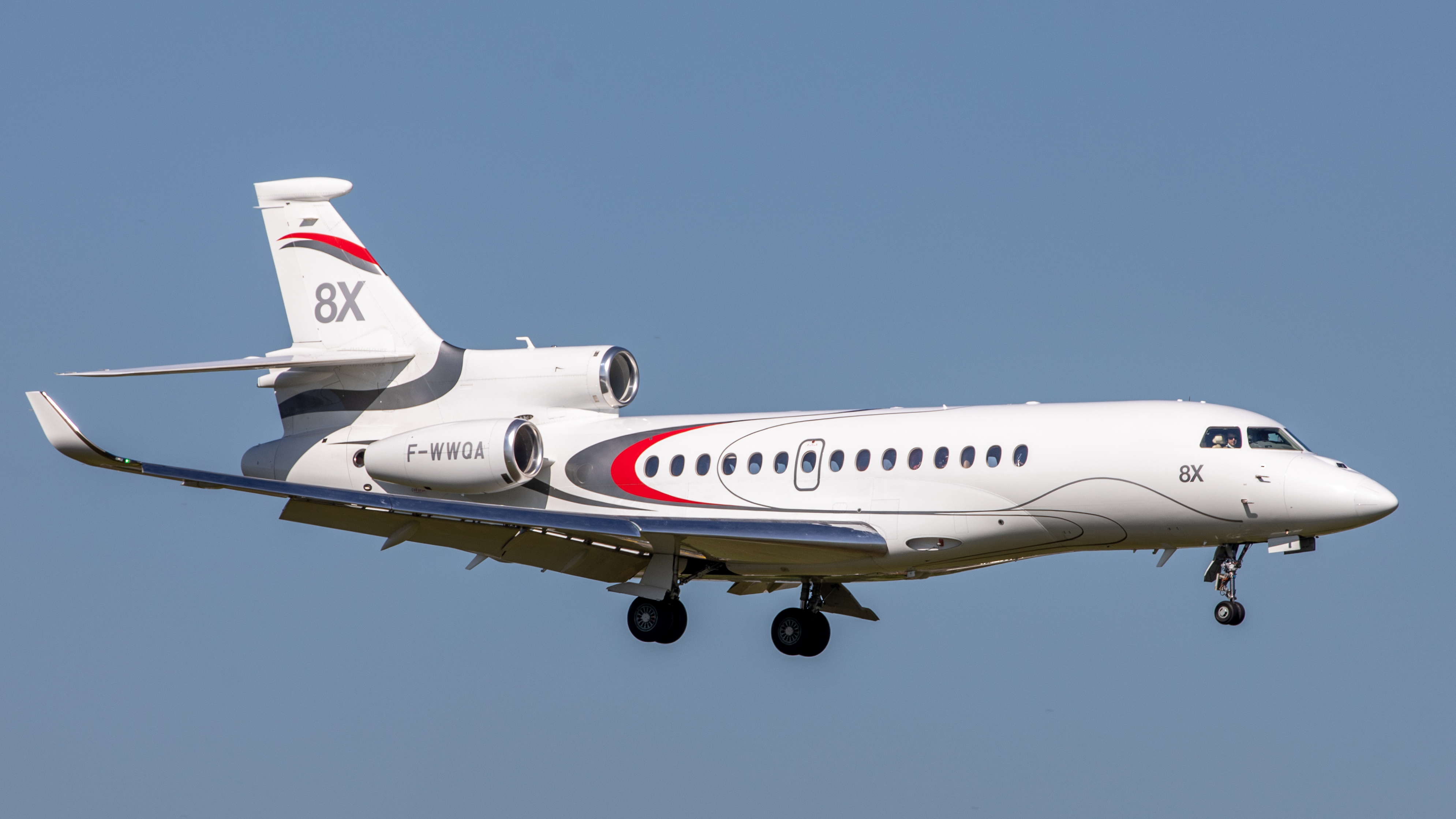 Dassault Falcon 8X at the Paris Air Show — Dassault's signature trijet design, prized for reliability and short-field capability. Photo: Wikimedia Commons.
6. Ultra Long-Range / Long-Range Jets
- Typical capacity: 12–19 passengers
- Typical range: ~6,500 nm (~12,040 km) and beyond
- Aircraft: Bombardier Global 6500 / 7500 / 8000, Gulfstream G500 / G550 / G650 / G700, Dassault Falcon 7X / 8X / 10X
This is the apex of business aviation. The Gulfstream G650ER set multiple city-pair speed records and regularly flies Singapore → San Francisco (7,650 nm / 14,170 km) nonstop. The Bombardier Global 8000, certified in 2025, is currently the fastest civilian jet (Mach 0.94) and the longest-range at 8,000 nm3. Cabins typically include a master suite, a dedicated crew rest area, full galley and multiple seating zones.
Best for: Intercontinental, head-of-state missions, routes like New York → Dubai, London → Tokyo, Los Angeles → Sydney.
 Qatar Executive's Gulfstream G650ER at EBACE, Geneva. The ULR category defines modern intercontinental business aviation. Photo: Wikimedia Commons.
How category affects your flight planning
| Category | Cabin height | Wi-Fi standard | Typical short-field perf | Sample 10 h charter cost* |
|---|---|---|---|---|
| VLJ | 1.40 m | Optional | Yes | €15–25k |
| Light | 1.45 m | Optional | Yes | €25–35k |
| Midsize | 1.73 m | Yes | Most | €35–50k |
| Super-midsize | 1.83 m | Yes | Some | €50–70k |
| Large | 1.88 m | Yes | Few | €70–100k |
| Ultra long-range | 1.88–1.98 m | Yes (SatCom) | Limited | €100k+ |
*Indicative charter block rates, Europe-based. Actual quotes vary by operator, repositioning, season, airport fees and crew duty. These are not binding quotes.
How to pick the right category for your flight
- Check the range. Your departure-to-arrival great-circle distance plus a 200 nm reserve should fit inside the jet's book range.
- Match the passenger count. VLJ for 3 pax; light for 5; midsize for 7; super-mid for 9; large for 11+; ULR for 13+.
- Look at the runway at your destination. Some FBOs are on short or high-altitude fields — not every category fits every airport.
- Factor in duty time. A light jet might technically make the trip but will need fuel stops that eat into your savings on total block time.
The FBO Finder map shows the private terminals at every airport, so you can check whether your chosen FBO has hangar space for a large-cabin jet, Jet A1 fuel for an overseas ULR, or simply fits your timeline.
Sources
- Dassault Aviation — Falcon family. Trijet heritage and Falcon 900/7X/8X/10X specifications.
- Gulfstream — G650 fact sheet. G650/G650ER range records.
Ranges and capacities are industry averages from public manufacturer data; actual figures depend on operating weight, winds aloft and cabin configuration. Charter prices are indicative European block rates and should not be treated as a quote. Article last updated April 16, 2026.
Footnotes
-
Business jet — Wikipedia. Category definitions, typical range and capacity averages. ↩
-
Embraer — Phenom 300 product information. Manufacturer announcements regarding delivery leadership. ↩
-
Bombardier — Global 8000. Certified specifications: Mach 0.94, 8,000 nm. ↩